For the past week, team equipment trucks have been motoring to Arizona and Florida. Spring training begins in about a week.
But about half of the Top 50 free agents remain unsigned. And the prospects of mega-deal long term contracts are fading fast.
The new free agent dogma is actually the renewal of the old ownership system. Way back, teams used to be owned by individuals or families. The baseball club was their sole business. They operated it like a mom and pop store. If they could get by cutting corners (player salaries) to make a profit, they made a profit first.
Small market clubs still operate under that guide line. Low attendance, small fan base, and lower local television deals means these clubs are under financial pressure against signing a player to a large contract. But under the CBA and baseball rules, all the small market teams have enhanced revenue sharing from the league, and extra draft picks to acquire "cheap" young talent to remain "competitive."
General managers now covet draft picks because they can retain a player for six years (three in arbitration) at a relative small cost. The farm system is now the most important aspect of the operations. If you can draft and develop talent consistently, your team can be frugal, competitive and profitable.
In order to do so, teams now "tank" more often to obtain higher "can't miss" prospects. It is okay to tank if you have very little fans to complain (see, Marlins.)
You have now about one-third (1/3) of MLB clubs at the bottom in salary budgets, many whom have little desire but to tank to acquire top ten draft picks.
You have the top four spenders, big market clubs, who are at the luxury cap limit of $206 million. These previously annual big spenders do not want to go over the salary cap because of the financial and draft penalties. To take on a salary like Harper's $30 million/year $300 million total, it could cost a team over the cap as much as another $300 million in penalties over that ten year period. To avoid that, the team would have to off-set or cut $30 million a year for the duration of the contract (which some GMs would classify as three veteran players or four quality relief pitchers in value.)
The rest of the clubs position themselves to spend $100 to $150 million per year. If their division is weak, like the AL Central, they could be in contention most of the season (thus validating their "plan" to their fans). Fair weather fans might return so everybody is happy. But with an average starting pitcher making $10 million, a team could have almost one-third of their payroll in a rotation. That leaves an average salary of $4 million for every other player on the roster. That is why prospects being paid the league minimum ($555,000) are so important as they free up money to sign or retain veteran players (second tier).
Player agents may be late to recognize this new paradigm being the old system before steroid fueled free agency. Teams now have the MBAs, computer geeks and stat analysts crunching big data to find that players over 30 in the non-steroid era are not as valuable or productive going forward. So many teams have been burned by long term, dead money contracts to be gun-shy about signing another player demanding even more money.
It seems that Harper's foray (or folly) into free agent basically ended when he rejected the Nationals pre-free agency extension of $300 million/30 years. Machado has not formally rejected the White Sox $175 million offer, but it seems no one else has topped it. The Phils said they would spend "stupid money," and if that was the case Harper and/or Machado would have had last month a press conference in Philadelphia. Agents must be frustrated by the "take it or leave it" offers from teams (who are giving their best contract first without being pushed and pulled by other teams or the agent.) Free agency is no longer a live auction between teams. It is more like a Priceline value search.

Showing posts with label stats. Show all posts
Showing posts with label stats. Show all posts
February 6, 2019
April 3, 2018
THE EARLY LINE
By most expectations, the Cubs are off to a bad start. Going 2-2 against the AAA Dead Fish is not what people thought of Cubs after spring training.
But the same problems from last season's disappointment are cropping up again.
After 5 games, the Cubs are batting .204. The team has struck out 58 times in 229 plate appearances. That is more than a quarter of at bats. The Cubs have not scored in 17 innings.
People realize that the Cubs offense is falling back in the trap of "home run or bust" approach to the plate. As noted in the last few years, the Cubs have bashers not contact hitters. Many clubs have a balanced lineup with .300 hitters and RBI guys. The 2018 Astros have 4 of their 9 hitters batting over .300. In 2017, the Astros had 6 players (with 2 utility guys) hitting at or over .300. In 2017, the Cubs had only one player (reserve catcher Rene Rivera) hit over .300.
Just as bad is the starting pitching. Traditionally, a team looked to its rotation to eat up innings (because starters were the best pitchers on your staff). Teams now expect starters to get to 200 IP (which is well below a generation ago where 250 IP was the norm). Even so, teams have to cover at least 1476 innings per season. If starters cover 1000 IP, that means the bullpen must cover 476 IP. In an 8 man bullpen, that means about 60 IP per reliever (which equates to almost 60 appearances per bullpen arm). That represents a lot of wear and tear on bullpen arms which now have to cover a third of each contest.
The Cubs starters have only thrown 25.2 IP in the first five games, or only 49.2 percent of games. The starters should be covering 67 percent.
It may be a small sample size, but it is still evidence of issues that need to be resolved by Maddon and the coaching staff. The Cubs needed to get off to a fast start to not give the Brewers or Cardinals any confidence to contend in the NL Central. The Cubs should have feasted on Marlins and Reds pitching.
But the same problems from last season's disappointment are cropping up again.
After 5 games, the Cubs are batting .204. The team has struck out 58 times in 229 plate appearances. That is more than a quarter of at bats. The Cubs have not scored in 17 innings.
People realize that the Cubs offense is falling back in the trap of "home run or bust" approach to the plate. As noted in the last few years, the Cubs have bashers not contact hitters. Many clubs have a balanced lineup with .300 hitters and RBI guys. The 2018 Astros have 4 of their 9 hitters batting over .300. In 2017, the Astros had 6 players (with 2 utility guys) hitting at or over .300. In 2017, the Cubs had only one player (reserve catcher Rene Rivera) hit over .300.
Just as bad is the starting pitching. Traditionally, a team looked to its rotation to eat up innings (because starters were the best pitchers on your staff). Teams now expect starters to get to 200 IP (which is well below a generation ago where 250 IP was the norm). Even so, teams have to cover at least 1476 innings per season. If starters cover 1000 IP, that means the bullpen must cover 476 IP. In an 8 man bullpen, that means about 60 IP per reliever (which equates to almost 60 appearances per bullpen arm). That represents a lot of wear and tear on bullpen arms which now have to cover a third of each contest.
The Cubs starters have only thrown 25.2 IP in the first five games, or only 49.2 percent of games. The starters should be covering 67 percent.
It may be a small sample size, but it is still evidence of issues that need to be resolved by Maddon and the coaching staff. The Cubs needed to get off to a fast start to not give the Brewers or Cardinals any confidence to contend in the NL Central. The Cubs should have feasted on Marlins and Reds pitching.

July 11, 2017
BREAK DOWN
Two games under .500. Five and one-half games behind the NL Central leader.
The Milwaukee Brewers would have been thrilled with that position prior to the All-Star game.
But it is the Cubs that are in that unexpected position, looking up at the rebuilding Brewers.
It has been a rocky 2017 campaign for the Cubs. The team has only one 5 game win streak and one 4 game win streak. The team has one 5 game losing streak and two 4 game losing streaks.
The vaulted Cub defense from 2016 has been terrible. The Cubs are 14th in the NL in errors and 13th in the league in fielding percentage.
The offense has not been exempt from criticism.
Runs Scored: 399/ 11th in NL
Hits: 706/14th
HR: 117/6th
BA: .239/14th
SB: 26/14th
The pitching numbers show a sad tale as well.
ERA: 4.10/5th in NL
CG: 1/6th
SHO: 0/10th
Runs Allowed: 399/5th
Earned Runs Allowed: 358/4th
Home Runs Allowed: 105/7th
Strikeouts: 763/4th
Walks: 309/10th
The cringe worthy stat is 1st Inning starting pitching (from ESPN):
Pitcher 2017 ERA 2016 ERA
Lackey 6.35 4.01
Lester 7.85 3.76
Arrieta 6.50 2.52
Anderson 21.94 4.30
Hendricks 5.73 3.72
Butler 4.09 8.04
Montgomery 7.11 4.37
Rotation: 7.34 3.85
A few years ago, the White Sox had a similar problem with a few of their starting pitchers. Steve Stone remarked that a rough first inning to him meant that the pitcher did not throw enough warm-up pitches prior to the game. He was not in game condition. The first inning was really the last stages of a normal warm up routine. Some pitchers coming off injury or protecting from injury tend to cut back on warm up tosses. The Cubs went into spring training with the direct order not to overwork their starting pitchers who threw into November. But that order may have carried over into the regular season.
A couple of Cubs starters also remarked that there was going to be an adjustment to the pregame rituals since the bullpen was no longer on Wrigley Field. Pitchers said they used to get positive energy from the fans in the stands when they warmed up. But now that they are under the bleachers, they do not get the crowd noise, the atmosphere of the pregame or the exact weather conditions on the field.
The Cubs have broken down in all phases of the game: hitting, pitching and fielding.
The excuses have to be laid to rest this late in the season:
The team is still young; they will get better. Except, there is no historical evidence that the young players hitting below .230 are going to hit .300 when they have never hit that high in the major league careers. There is something to the sophomore slump in the majors because the other teams find weaknesses in their opponents, especially batters.
Once the summer heats up, so will the bats. This is a false myth. In Chicago, it has been above average in temperature since May. The Cub bats have been consistently mediocre all season, especially with runners in scoring position.
The NL Central is weak so the Cubs can easily come back to win it. No one believed the Brewers were contenders but they have been on top for most of the season. They believe they can win it. Their make-up contest blow-out against the Cubs was a statement game. The team will get back its best starting pitcher, Chase Anderson, from his second oblique injury. Rumors have it that the Brewers could trade for Jose Quintana which would solidify their rotation for a stretch run. In addition, the Pirates came to town before the break and beat up the Cubs. They may have turned their season around with a revived Andrew McCutheon.
The Cubs won it last year; they know what to do to win it this year. This assumes that the 2017 Cubs are the same as the 2016 team. The current Cubs are missing the leadership of David Ross (especially when it comes to talking to the starting pitchers). The team is also missing its lead off hitter in Dexter Fowler. As a carryover from Game 7, the team may have stopped listening to sugar-coated hipness of Joe Maddon's happy team routine. The Cubs accomplished a serious goal last season in winning the World Series. This year, the Cubs do not have the same type of goal or a sense of urgency to contend.
More die-hard fans feel that the 2017 Cubs will be a major disappointment and they may end the season a below .500 club. It will really depend on whether the Cubs can start off hot after the All-Star game.
The Milwaukee Brewers would have been thrilled with that position prior to the All-Star game.
But it is the Cubs that are in that unexpected position, looking up at the rebuilding Brewers.
It has been a rocky 2017 campaign for the Cubs. The team has only one 5 game win streak and one 4 game win streak. The team has one 5 game losing streak and two 4 game losing streaks.
The vaulted Cub defense from 2016 has been terrible. The Cubs are 14th in the NL in errors and 13th in the league in fielding percentage.
The offense has not been exempt from criticism.
Runs Scored: 399/ 11th in NL
Hits: 706/14th
HR: 117/6th
BA: .239/14th
SB: 26/14th
The pitching numbers show a sad tale as well.
ERA: 4.10/5th in NL
CG: 1/6th
SHO: 0/10th
Runs Allowed: 399/5th
Earned Runs Allowed: 358/4th
Home Runs Allowed: 105/7th
Strikeouts: 763/4th
Walks: 309/10th
The cringe worthy stat is 1st Inning starting pitching (from ESPN):
Pitcher 2017 ERA 2016 ERA
Lackey 6.35 4.01
Lester 7.85 3.76
Arrieta 6.50 2.52
Anderson 21.94 4.30
Hendricks 5.73 3.72
Butler 4.09 8.04
Montgomery 7.11 4.37
Rotation: 7.34 3.85
A few years ago, the White Sox had a similar problem with a few of their starting pitchers. Steve Stone remarked that a rough first inning to him meant that the pitcher did not throw enough warm-up pitches prior to the game. He was not in game condition. The first inning was really the last stages of a normal warm up routine. Some pitchers coming off injury or protecting from injury tend to cut back on warm up tosses. The Cubs went into spring training with the direct order not to overwork their starting pitchers who threw into November. But that order may have carried over into the regular season.
A couple of Cubs starters also remarked that there was going to be an adjustment to the pregame rituals since the bullpen was no longer on Wrigley Field. Pitchers said they used to get positive energy from the fans in the stands when they warmed up. But now that they are under the bleachers, they do not get the crowd noise, the atmosphere of the pregame or the exact weather conditions on the field.
The Cubs have broken down in all phases of the game: hitting, pitching and fielding.
The excuses have to be laid to rest this late in the season:
The team is still young; they will get better. Except, there is no historical evidence that the young players hitting below .230 are going to hit .300 when they have never hit that high in the major league careers. There is something to the sophomore slump in the majors because the other teams find weaknesses in their opponents, especially batters.
Once the summer heats up, so will the bats. This is a false myth. In Chicago, it has been above average in temperature since May. The Cub bats have been consistently mediocre all season, especially with runners in scoring position.
The NL Central is weak so the Cubs can easily come back to win it. No one believed the Brewers were contenders but they have been on top for most of the season. They believe they can win it. Their make-up contest blow-out against the Cubs was a statement game. The team will get back its best starting pitcher, Chase Anderson, from his second oblique injury. Rumors have it that the Brewers could trade for Jose Quintana which would solidify their rotation for a stretch run. In addition, the Pirates came to town before the break and beat up the Cubs. They may have turned their season around with a revived Andrew McCutheon.
The Cubs won it last year; they know what to do to win it this year. This assumes that the 2017 Cubs are the same as the 2016 team. The current Cubs are missing the leadership of David Ross (especially when it comes to talking to the starting pitchers). The team is also missing its lead off hitter in Dexter Fowler. As a carryover from Game 7, the team may have stopped listening to sugar-coated hipness of Joe Maddon's happy team routine. The Cubs accomplished a serious goal last season in winning the World Series. This year, the Cubs do not have the same type of goal or a sense of urgency to contend.
More die-hard fans feel that the 2017 Cubs will be a major disappointment and they may end the season a below .500 club. It will really depend on whether the Cubs can start off hot after the All-Star game.
June 15, 2017
BY THE NUMBERS
Forty percent of the season has been played but the Cubs are still stuck in a bad neutral position. Nothing is consistent except their inconsistency.
People are trying to find out what is wrong with the new Cub dynasty. Maddon said yesterday maybe "youth" is to blame.
Both hitters and pitchers are to blame.
In 2016, the Cubs hit .256 BA (6th in NL). In 2017, the team is hitting only .235 (14th). It is more than an 8 percent drop in production.
In 2016, the Cubs scored 808 runs (2nd in the NL). In 2017, the team has scored only 304 runs (8th). The Cubs 2017 run scoring is down 6 percent from 2016.
In 2016, the Cubs had 1409 hits (7th in NL). In 2017, only 517 hits (14th). It is an 8.6 percent decline in hits per game (8.7 vs. 7.95).
In 2016, the Cubs 199 HRs (5th in NL). In 2017, 90 HR (5th). The current Cubs are hitting more HR/G than last season, but scoring less runs.
In 2016, the Cubs stole 66 bases (11th in NL). In 2017, the team has 18 SB (last in NL). That is a 27.7 percent decrease in stolen bases.
In 2016, the Cubs walked 656 times (1st in NL). In 2017, the team has 260 walks (1st). Walks are only down 1.25 percent this season.
In 2016, the team OBP was .343 (1st in NL). In 2017, it is .324 (9th). That is more than a 5.5 percent decline in production.
For team pitching, it is more severe.
In 2016, the team ERA was 3.15 (1st). In 2017, team ERA is 4.20 (5th). It is more than one run higher this year. It is a 33 percent increase in ERA.
In 2016, the Cubs were best in hits allowed at 1125. In 2017, the staff has allowed 542 hits (5th in NL). That is 1.40 more hits per game (a 20 percent increase).
In 2016, the Cubs walked 495 batters (7th in NL). In 2017, the staff has walked 223 (9th in NL). That is a 12.5 percent increase in walks.
In 2016, the Cubs truck out 1441 batters (3rd in NL). In 2017, it is 593 (4th). The 2017 Cubs are striking out more batters this season 9.12/G vs. 2016 8.9/G.
In 2016, the staff WHIP was 1.110. In 2017, it is 1.308. That is a 17.8 percent increase in WHIP.
The 2017 Cubs have maintained or done better than last year in only these categories:
HITTING:
Home Runs
Team walks
PITCHING:
Strike Outs
The striking double digit declines come in pitching categories (ERA, hits allowed, walks allowed, WHIP). There is more than 8 percent decline in hitting categories (BA, hits per game, stolen bases).
People are trying to find out what is wrong with the new Cub dynasty. Maddon said yesterday maybe "youth" is to blame.
Both hitters and pitchers are to blame.
In 2016, the Cubs hit .256 BA (6th in NL). In 2017, the team is hitting only .235 (14th). It is more than an 8 percent drop in production.
In 2016, the Cubs scored 808 runs (2nd in the NL). In 2017, the team has scored only 304 runs (8th). The Cubs 2017 run scoring is down 6 percent from 2016.
In 2016, the Cubs had 1409 hits (7th in NL). In 2017, only 517 hits (14th). It is an 8.6 percent decline in hits per game (8.7 vs. 7.95).
In 2016, the Cubs 199 HRs (5th in NL). In 2017, 90 HR (5th). The current Cubs are hitting more HR/G than last season, but scoring less runs.
In 2016, the Cubs stole 66 bases (11th in NL). In 2017, the team has 18 SB (last in NL). That is a 27.7 percent decrease in stolen bases.
In 2016, the Cubs walked 656 times (1st in NL). In 2017, the team has 260 walks (1st). Walks are only down 1.25 percent this season.
In 2016, the team OBP was .343 (1st in NL). In 2017, it is .324 (9th). That is more than a 5.5 percent decline in production.
For team pitching, it is more severe.
In 2016, the team ERA was 3.15 (1st). In 2017, team ERA is 4.20 (5th). It is more than one run higher this year. It is a 33 percent increase in ERA.
In 2016, the Cubs were best in hits allowed at 1125. In 2017, the staff has allowed 542 hits (5th in NL). That is 1.40 more hits per game (a 20 percent increase).
In 2016, the Cubs walked 495 batters (7th in NL). In 2017, the staff has walked 223 (9th in NL). That is a 12.5 percent increase in walks.
In 2016, the Cubs truck out 1441 batters (3rd in NL). In 2017, it is 593 (4th). The 2017 Cubs are striking out more batters this season 9.12/G vs. 2016 8.9/G.
In 2016, the staff WHIP was 1.110. In 2017, it is 1.308. That is a 17.8 percent increase in WHIP.
The 2017 Cubs have maintained or done better than last year in only these categories:
HITTING:
Home Runs
Team walks
PITCHING:
Strike Outs
The striking double digit declines come in pitching categories (ERA, hits allowed, walks allowed, WHIP). There is more than 8 percent decline in hitting categories (BA, hits per game, stolen bases).
June 3, 2017
QUICK FADE
In 2015, Pirate OF Andrew McCutcheon was on top of the baseball world. He was an All-Star. He was 5th in the MVP voting. He was only 28 years old. He was a leader in a resurgent, young Pittsburgh club.
He was rumored to be in trade talks (his contract expires in 2017). But the Pirates kept him to anchor CF and hit third in the lineup.
In 2015, McCutcheon hit .292, 23 HR, 96 RBI, .401 OBP, 4.9 WAR. Great production. Great teammate. Great clubhouse leader.
Then in 2016, things quickly began to turn. He hit .256, 24 HR, 79 RBI, .376 OBP and a negative 0.7 WAR. At age 29, his plate discipline (OBP) and defense began to diminish.
Now, 51 games into the 2017 season, writers are saying it is shocking that a 30 year old former All Star is a shell of his former self. He is hitting only .217, 8 HR, 24 RBI, .290 OBP, and negative 0.4 WAR. He can no longer handle center field duties. For an entire season, he projects to hit .217, 24 HR, 72 RBI, .290 OBP and negative 1.2 WAR.
One would think that injuries would be the cause of the massive production drop. In 2014, he had an oblique injury. In 2015, he was hit by a pitch on his elbow. Since then, there has been no reported major injury news.
This season he has been benched for lack of production, and dropped in the lineup to #6 (where he has recently responded with a GW HR).
But no one is seeing a great turnover by the former All Star.
Baseball is a hard and cruel game. There are so many moving mental and physical parts that a break down in one element can signal the end of a career. It is still shocking to see it happen so quickly to a player of the caliber of McCutcheon.
He was rumored to be in trade talks (his contract expires in 2017). But the Pirates kept him to anchor CF and hit third in the lineup.
In 2015, McCutcheon hit .292, 23 HR, 96 RBI, .401 OBP, 4.9 WAR. Great production. Great teammate. Great clubhouse leader.
Then in 2016, things quickly began to turn. He hit .256, 24 HR, 79 RBI, .376 OBP and a negative 0.7 WAR. At age 29, his plate discipline (OBP) and defense began to diminish.
Now, 51 games into the 2017 season, writers are saying it is shocking that a 30 year old former All Star is a shell of his former self. He is hitting only .217, 8 HR, 24 RBI, .290 OBP, and negative 0.4 WAR. He can no longer handle center field duties. For an entire season, he projects to hit .217, 24 HR, 72 RBI, .290 OBP and negative 1.2 WAR.
One would think that injuries would be the cause of the massive production drop. In 2014, he had an oblique injury. In 2015, he was hit by a pitch on his elbow. Since then, there has been no reported major injury news.
This season he has been benched for lack of production, and dropped in the lineup to #6 (where he has recently responded with a GW HR).
But no one is seeing a great turnover by the former All Star.
Baseball is a hard and cruel game. There are so many moving mental and physical parts that a break down in one element can signal the end of a career. It is still shocking to see it happen so quickly to a player of the caliber of McCutcheon.
August 17, 2015
A MISNOMER
The Cubs are 67-49.
Most people say that the Cubs are 18 games over .500.
That's great.
But I believe it is inaccurate.
The Cubs have played 116 games.
If the Cubs played .500 ball, they would have a record of 58-58.
58 wins is the .500 mark at this point in the season.
The Cubs are better, at 67 wins.
67 wins - 58 wins = 9 games above the .500 mark.
UPDATE 9/2/15
A Cardinal fan gloats that his team is now "40 games over .500." Radio, television and print media are proclaiming the accomplishment.
By Cardinal's "math," the team has 86 wins this season.
They claim that if the team is at 46-46, they are at .500.
46+40=86, so everyone on radio and TV the past 24 hours says the team is 40 games over .500.
They will also tell you that the Cubs are 19 over .500.
"It’s not that difficult to understand; it’s common baseball language and math!"
Again, the statement is inaccurate mathematically wrong because it does not take in account total games played in the equation.
They are only looking at total wins not total games played which is the problem.
The Cardinals are only .500 team if record is 46-46 (after playing 92 games).
After 132 games, if the team is at .500 that means their record is 66-66 not 46-46.
86 wins - 66 wins (for a .500 club) = 20 games over .500.
Most people say that the Cubs are 18 games over .500.
That's great.
But I believe it is inaccurate.
The Cubs have played 116 games.
If the Cubs played .500 ball, they would have a record of 58-58.
58 wins is the .500 mark at this point in the season.
The Cubs are better, at 67 wins.
67 wins - 58 wins = 9 games above the .500 mark.
UPDATE 9/2/15
A Cardinal fan gloats that his team is now "40 games over .500." Radio, television and print media are proclaiming the accomplishment.
By Cardinal's "math," the team has 86 wins this season.
They claim that if the team is at 46-46, they are at .500.
46+40=86, so everyone on radio and TV the past 24 hours says the team is 40 games over .500.
They will also tell you that the Cubs are 19 over .500.
"It’s not that difficult to understand; it’s common baseball language and math!"
Again, the statement is inaccurate mathematically wrong because it does not take in account total games played in the equation.
They are only looking at total wins not total games played which is the problem.
The Cardinals are only .500 team if record is 46-46 (after playing 92 games).
After 132 games, if the team is at .500 that means their record is 66-66 not 46-46.
86 wins - 66 wins (for a .500 club) = 20 games over .500.
August 14, 2015
THE DINOSAUR CALLED A WALK
People don't come to the ball park and pay $100/ticket to watch superstars walk.
"Chicks did the long ball."
Remember?
Well CNBC noticed that walks are way down while strikeouts are way up.
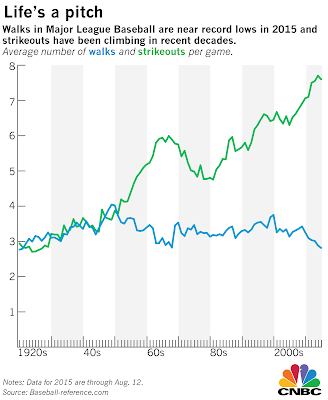
The article states that through August, Major League Baseball saw an average of 2.8 walks per game. If the season were to end there, that would be the lowest level since the 1920s. Similarly, a lot of the stats show that pitching is dominating over hitting. Strikeouts are up, batting average is down, among other key statistics.
"Back in the 1990s, there was a panic in the industry
about lack of pitching," Beane told CNBC. "Now you have a big wave of
pitching that is physically so much different."
Beane noted the increase in physical domination of today's pitcher. "When I was playing, you might have a few guys that threw over 90 miles per hour, but now you have entire staffs where average velocity on fastballs is 2-3 mph faster than a few years ago."
The average fastball in the first half of 2015 left the pitcher's hand at 91.7 mph, according to Major League
Baseball's pitch(f)x database. That's more than a full mph faster than the 2008 average of 90.6.
All-Star hitters agree. "The pitchers these days throw harder and can throw their off-speed pitches for strikes," Mark Teixeira told CNBC. "They're just better."
The New York Yankees first baseman agreed with Beane that this year in particular has been different. "It is definitely getting hard to walk in the big leagues. I feel the trend started a few years ago and is getting more pronounced this season."
During the steroid era, hitters were much more aggressive at the plate because the key stats to earn large contracts were home runs and RBIs. The big hitters got the big money. It did not matter that they swung and missed at a ton of pitches. It really did not matter that their batting average was below .270. To them, an out was an out - - - it did not matter whether it was a strikeout or a long fly ball to the CF on the warning track.
One of the keys to the Cubs current success has been "draft bats, buy pitching." The young Cub hitters can hit for power, but have been drilled to "accept" a walk to keep an inning alive. That is team play in an generation that is mostly focused on "I."
The Blue Jays recent surge has been triggered by adding more bats to an already potent line up.
On the other hand, the Mets have done the opposite. "Draft pitching, acquire bats." The Mets have the finest young rotation in the majors. It has been dominate all year. The old school saying is "good pitching will always defeat good hitting" is the motto for a Mets playoff run.
Why there are less walks and more strikeouts is because there is no stigma attached to striking out. You don't feel bad or get razzed when you sulk back to the dugout after a K. Likewise, no one rewards a player for getting a walk. It does not add points to a batting average. It is like a kindergarten star on a hand-traced turkey because even teams that stress OBP don't hold their players to it.
"Chicks did the long ball."
Remember?
Well CNBC noticed that walks are way down while strikeouts are way up.

The article states that through August, Major League Baseball saw an average of 2.8 walks per game. If the season were to end there, that would be the lowest level since the 1920s. Similarly, a lot of the stats show that pitching is dominating over hitting. Strikeouts are up, batting average is down, among other key statistics.
"It's like capitalism," said Oakland A's general manager Billy Beane. "You have a
void that needs to be filled, and a whole generation of kids that see
it. You've got talent in the pitching department now that is so far above what it was in the past."
Beane noted the increase in physical domination of today's pitcher. "When I was playing, you might have a few guys that threw over 90 miles per hour, but now you have entire staffs where average velocity on fastballs is 2-3 mph faster than a few years ago."
The average fastball in the first half of 2015 left the pitcher's hand at 91.7 mph, according to Major League
Baseball's pitch(f)x database. That's more than a full mph faster than the 2008 average of 90.6.
All-Star hitters agree. "The pitchers these days throw harder and can throw their off-speed pitches for strikes," Mark Teixeira told CNBC. "They're just better."
The New York Yankees first baseman agreed with Beane that this year in particular has been different. "It is definitely getting hard to walk in the big leagues. I feel the trend started a few years ago and is getting more pronounced this season."
During the steroid era, hitters were much more aggressive at the plate because the key stats to earn large contracts were home runs and RBIs. The big hitters got the big money. It did not matter that they swung and missed at a ton of pitches. It really did not matter that their batting average was below .270. To them, an out was an out - - - it did not matter whether it was a strikeout or a long fly ball to the CF on the warning track.
One of the keys to the Cubs current success has been "draft bats, buy pitching." The young Cub hitters can hit for power, but have been drilled to "accept" a walk to keep an inning alive. That is team play in an generation that is mostly focused on "I."
The Blue Jays recent surge has been triggered by adding more bats to an already potent line up.
On the other hand, the Mets have done the opposite. "Draft pitching, acquire bats." The Mets have the finest young rotation in the majors. It has been dominate all year. The old school saying is "good pitching will always defeat good hitting" is the motto for a Mets playoff run.
Why there are less walks and more strikeouts is because there is no stigma attached to striking out. You don't feel bad or get razzed when you sulk back to the dugout after a K. Likewise, no one rewards a player for getting a walk. It does not add points to a batting average. It is like a kindergarten star on a hand-traced turkey because even teams that stress OBP don't hold their players to it.
April 22, 2015
LESTER TEN PERCENT SOLUTION
Jon Lester has made three starts for the Cubs. Based upon projections, that is about 10 percent of his expected starts for 2015.
PERCOTA estimated Lester's Cub season as follows:
26 Games started
11-9 record
3.62 ERA
182.0 IP
155 H
1.14 WHIP
After 3 games with the Cubs:
0-2 record
6.89 ERA
15.2 IP
24 H
1.79 WHIP
PERCOTA had Lester allowing .85 hits/IP. Currently, Lester is allowing 1.53 hits/IP which is 80 percent more than projected by the stat service.
Control is also an issue. His current WHIP is 57 percent higher than PERCOTA.
It cannot be a difference in the leagues, since MLB no longer has separate umpire crews for the AL and NL (for a more consistent strike zone). The National League should be easier since there is no DH. There have been a few excuses that Lester's "dead" arm in spring training was no big deal, but clearly the idea that Lester needed one or two games in order to "finish" his spring training during the season is problematic. When one adds the national story on how Lester can't throw to first base, one has to wonder whether the big contract, control issues and comic jabs are going to negatively affect him. In order for Lester to come back to be even an average pitcher (.500 record, 4.00 ERA, 1.30 WHIP), he will need to throw three "lights out" games.
PERCOTA estimated Lester's Cub season as follows:
26 Games started
11-9 record
3.62 ERA
182.0 IP
155 H
1.14 WHIP
After 3 games with the Cubs:
0-2 record
6.89 ERA
15.2 IP
24 H
1.79 WHIP
PERCOTA had Lester allowing .85 hits/IP. Currently, Lester is allowing 1.53 hits/IP which is 80 percent more than projected by the stat service.
Control is also an issue. His current WHIP is 57 percent higher than PERCOTA.
It cannot be a difference in the leagues, since MLB no longer has separate umpire crews for the AL and NL (for a more consistent strike zone). The National League should be easier since there is no DH. There have been a few excuses that Lester's "dead" arm in spring training was no big deal, but clearly the idea that Lester needed one or two games in order to "finish" his spring training during the season is problematic. When one adds the national story on how Lester can't throw to first base, one has to wonder whether the big contract, control issues and comic jabs are going to negatively affect him. In order for Lester to come back to be even an average pitcher (.500 record, 4.00 ERA, 1.30 WHIP), he will need to throw three "lights out" games.
January 26, 2015
ICHIRO
41 year old Ichiro Suzuki is about to sign with Miami for probably one last season in the majors.
He is only 156 hits short of 3,000 as a U.S. MLB player, the milestone that still gets an automatic berth in the Hall of Fame. If you add in his Japanese hit totals, he is well over 4,000 professional hits.
He was an old school professional hitter, taking his hard swings and taking his choppy infield singles. He also was an above average outfielder with a good arm for his size. His success in Seattle opened the doors for many more Japanese ball players to be scouted and signed in the U.S.
He has led the league in hits for 7 of his 14 seasons in the U.S. He sports a career BA of .317. He won two batting titles. He hit 117 HR, 717 RBI and 487 RBI. He has a career war of 59.3.
When one goes by the standard of whether a HOF candidate was an "impact" player during his era, Ichiro would qualify. He probably will fall just short of 3,000 hits and 500 SB so some writers may put him in the "very good" player category like a Kenny Lofton.
He is only 156 hits short of 3,000 as a U.S. MLB player, the milestone that still gets an automatic berth in the Hall of Fame. If you add in his Japanese hit totals, he is well over 4,000 professional hits.
He was an old school professional hitter, taking his hard swings and taking his choppy infield singles. He also was an above average outfielder with a good arm for his size. His success in Seattle opened the doors for many more Japanese ball players to be scouted and signed in the U.S.
He has led the league in hits for 7 of his 14 seasons in the U.S. He sports a career BA of .317. He won two batting titles. He hit 117 HR, 717 RBI and 487 RBI. He has a career war of 59.3.
When one goes by the standard of whether a HOF candidate was an "impact" player during his era, Ichiro would qualify. He probably will fall just short of 3,000 hits and 500 SB so some writers may put him in the "very good" player category like a Kenny Lofton.
Subscribe to:
Posts (Atom)