ESPN's Buster Olney opines that many aspects of the traditional game of baseball are vanishing before our own eyes. Basic managerial strategies like the hit-and-run, or the squeeze bunt, or pitchouts, or stolen bases are all significantly down over the past decade.
The
game’s three true outcomes -- the strikeout, the walk, the home run --
have increased exponentially, and "like invasive species, they are
swallowing other parts of the game."
He blames the wide spread use of statistical models that are now ruling the game.
Pitchers are now being programmed to make exacting pitch locations with various pitches. So there is no emphasis on keeping a runner close at first base, or worse, wasting a pitch on a pitch out.
Likewise, runners have been taught that the risk-reward for stealing a base is not worth the chance. Unless you have an 80 percent success rate, it is better to stay close to the bag to wait for a batter to walk or hit a home run.
Even with a slow runner on first base, managers used to employ the hit-and-run. The reason was simple: once the runner broke to the bag, one middle infielder had to start moving to cover second. The motion of the defense created holes in the infield that could be exploited by a good contact hitter. But there is a huge lack of .300 contact hitters in the majors. Hitters are being more concerned about their launch angles (swings so they can hit HRs), exit velocity of the ball off the bat (for distance) and OBP (the general manager's pet statistic come contract renewal time.)
But with the statistical probability defensive grid shifts applied to every batter, the hit and run play may be the only way some batters can actually hit a grounder into the outfield for a single.
With a runner at third with less than two outs, the manager had several options to call. First, the batter could try to hit a deep fly ball to the outfield (sacrifice fly) to score the runner. Second, the batter could make the pitcher work a count, and in a high stress situation may throw a wild pitch to score the runner. Third, the batter could try to fool the infield with a "safety" squeeze in an attempt to get an infield single - - - and if the defenders were not paying attention, the runner from third could try to score in the confusion. Fourth, the manager could on the pitch send the runner racing for home forcing the batter to make any sort of contact in play so the runner could score (the suicide squeeze since the runner would be out if the batter failed to get contact).
Rarely does a manager call for a bunt. The problem is that players don't want to learn to bunt. Bunting does not help their stat line. Players would rather try to get a hit than sacrifice. Sacrifices are left to the weak hitting pitchers in the NL.
For some, major league baseball is now becoming a modified home run derby contest. It is swing for the fences or coax a walk. There is less strategy but more controversy about calls made by umpires (and the breakdown of replay to resolve issues).
Olney may be on to something. The game is supposed to have more moving parts than just pitching and hitting.

Showing posts with label walks. Show all posts
Showing posts with label walks. Show all posts
June 1, 2018
August 14, 2015
THE DINOSAUR CALLED A WALK
People don't come to the ball park and pay $100/ticket to watch superstars walk.
"Chicks did the long ball."
Remember?
Well CNBC noticed that walks are way down while strikeouts are way up.
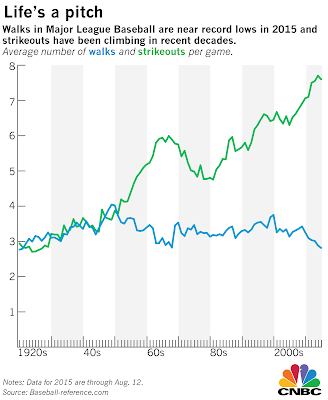
The article states that through August, Major League Baseball saw an average of 2.8 walks per game. If the season were to end there, that would be the lowest level since the 1920s. Similarly, a lot of the stats show that pitching is dominating over hitting. Strikeouts are up, batting average is down, among other key statistics.
"Back in the 1990s, there was a panic in the industry
about lack of pitching," Beane told CNBC. "Now you have a big wave of
pitching that is physically so much different."
Beane noted the increase in physical domination of today's pitcher. "When I was playing, you might have a few guys that threw over 90 miles per hour, but now you have entire staffs where average velocity on fastballs is 2-3 mph faster than a few years ago."
The average fastball in the first half of 2015 left the pitcher's hand at 91.7 mph, according to Major League
Baseball's pitch(f)x database. That's more than a full mph faster than the 2008 average of 90.6.
All-Star hitters agree. "The pitchers these days throw harder and can throw their off-speed pitches for strikes," Mark Teixeira told CNBC. "They're just better."
The New York Yankees first baseman agreed with Beane that this year in particular has been different. "It is definitely getting hard to walk in the big leagues. I feel the trend started a few years ago and is getting more pronounced this season."
During the steroid era, hitters were much more aggressive at the plate because the key stats to earn large contracts were home runs and RBIs. The big hitters got the big money. It did not matter that they swung and missed at a ton of pitches. It really did not matter that their batting average was below .270. To them, an out was an out - - - it did not matter whether it was a strikeout or a long fly ball to the CF on the warning track.
One of the keys to the Cubs current success has been "draft bats, buy pitching." The young Cub hitters can hit for power, but have been drilled to "accept" a walk to keep an inning alive. That is team play in an generation that is mostly focused on "I."
The Blue Jays recent surge has been triggered by adding more bats to an already potent line up.
On the other hand, the Mets have done the opposite. "Draft pitching, acquire bats." The Mets have the finest young rotation in the majors. It has been dominate all year. The old school saying is "good pitching will always defeat good hitting" is the motto for a Mets playoff run.
Why there are less walks and more strikeouts is because there is no stigma attached to striking out. You don't feel bad or get razzed when you sulk back to the dugout after a K. Likewise, no one rewards a player for getting a walk. It does not add points to a batting average. It is like a kindergarten star on a hand-traced turkey because even teams that stress OBP don't hold their players to it.
"Chicks did the long ball."
Remember?
Well CNBC noticed that walks are way down while strikeouts are way up.

The article states that through August, Major League Baseball saw an average of 2.8 walks per game. If the season were to end there, that would be the lowest level since the 1920s. Similarly, a lot of the stats show that pitching is dominating over hitting. Strikeouts are up, batting average is down, among other key statistics.
"It's like capitalism," said Oakland A's general manager Billy Beane. "You have a
void that needs to be filled, and a whole generation of kids that see
it. You've got talent in the pitching department now that is so far above what it was in the past."
Beane noted the increase in physical domination of today's pitcher. "When I was playing, you might have a few guys that threw over 90 miles per hour, but now you have entire staffs where average velocity on fastballs is 2-3 mph faster than a few years ago."
The average fastball in the first half of 2015 left the pitcher's hand at 91.7 mph, according to Major League
Baseball's pitch(f)x database. That's more than a full mph faster than the 2008 average of 90.6.
All-Star hitters agree. "The pitchers these days throw harder and can throw their off-speed pitches for strikes," Mark Teixeira told CNBC. "They're just better."
The New York Yankees first baseman agreed with Beane that this year in particular has been different. "It is definitely getting hard to walk in the big leagues. I feel the trend started a few years ago and is getting more pronounced this season."
During the steroid era, hitters were much more aggressive at the plate because the key stats to earn large contracts were home runs and RBIs. The big hitters got the big money. It did not matter that they swung and missed at a ton of pitches. It really did not matter that their batting average was below .270. To them, an out was an out - - - it did not matter whether it was a strikeout or a long fly ball to the CF on the warning track.
One of the keys to the Cubs current success has been "draft bats, buy pitching." The young Cub hitters can hit for power, but have been drilled to "accept" a walk to keep an inning alive. That is team play in an generation that is mostly focused on "I."
The Blue Jays recent surge has been triggered by adding more bats to an already potent line up.
On the other hand, the Mets have done the opposite. "Draft pitching, acquire bats." The Mets have the finest young rotation in the majors. It has been dominate all year. The old school saying is "good pitching will always defeat good hitting" is the motto for a Mets playoff run.
Why there are less walks and more strikeouts is because there is no stigma attached to striking out. You don't feel bad or get razzed when you sulk back to the dugout after a K. Likewise, no one rewards a player for getting a walk. It does not add points to a batting average. It is like a kindergarten star on a hand-traced turkey because even teams that stress OBP don't hold their players to it.

July 28, 2015
UMPS LOOKING OVER THEIR SHOULDER
Baseball umpires have gotten worse, right?
So they should be replaced, right?
Well, science steps up to the plate next week:
The independent San Rafael Pacifics will use a computerized video system to call balls and strikes tonight and Wednesday in their games at Albert Park in San Rafael.
They’re billed as the first professional games in which a human won’t call balls and strikes. Hall of Famer Mike Schmidt has expressed his desire for an automated strike zone.
Calls will be made by the Pitch F/X system with three cameras forming a triangular effect that judges a pitch’s trajectory and speed as it crosses the plate. Pitch F/X is used on TV broadcasts to determine a pitch’s location and also for umpires to judge their work.
Eric Byrnes, a former A’s outfielder and proponent of an automated strike zone, will serve as the “strike zone umpire” and oversee the Pitch F/X system, a product of Fremont-based Sportvision Inc.
This should be an interesting live experiment of pitch zone technology. Since baseball viewers are used to Pitch Track on their television screens during games, most fans will accept the concept of a computer strike zone. Whether science makes a 3D box work is another question. And how will it slow down the game?
Tennis has had censors for serves for a long time. Initially, players and fans objected to the technology believing the human eye is faster and more accurate than a machine.
So they should be replaced, right?
Well, science steps up to the plate next week:
The independent San Rafael Pacifics will use a computerized video system to call balls and strikes tonight and Wednesday in their games at Albert Park in San Rafael.
They’re billed as the first professional games in which a human won’t call balls and strikes. Hall of Famer Mike Schmidt has expressed his desire for an automated strike zone.
Calls will be made by the Pitch F/X system with three cameras forming a triangular effect that judges a pitch’s trajectory and speed as it crosses the plate. Pitch F/X is used on TV broadcasts to determine a pitch’s location and also for umpires to judge their work.
Eric Byrnes, a former A’s outfielder and proponent of an automated strike zone, will serve as the “strike zone umpire” and oversee the Pitch F/X system, a product of Fremont-based Sportvision Inc.
This should be an interesting live experiment of pitch zone technology. Since baseball viewers are used to Pitch Track on their television screens during games, most fans will accept the concept of a computer strike zone. Whether science makes a 3D box work is another question. And how will it slow down the game?
Tennis has had censors for serves for a long time. Initially, players and fans objected to the technology believing the human eye is faster and more accurate than a machine.
May 12, 2015
REVERSION TO A MEAN
The Cubs started off the season with some new found plate discipline.
However, with the weather changing so has the home run swing attitude.
The Cubs team strike out totals have increased quickly back to bad form.
The Cubs lead the National League in team Ks with 312. The league average is 242.
The Cubs have 70 more strikeouts (29% above the league average).
In 31 games played, the Cubs average 10.06 K/G. The league average is 7.56 K/G. That means the Cubs are striking out 2.5 times more per game than the league. That means that the Cubs are basically giving away an inning a game by not putting a ball into play.
On a brighter note, the Cubs are still above average in walks. The Cubs have "accepted" in Maddon's terms 107 base on balls, while the NL team average is 94. That means the Cubs have 0.42 more walks per game than the league average.
Putting the two stats together, we find that the Cubs new mean is still about 2.1 more strikeouts (being unproductive outs) than the league average.
Given that a team only gets 27 outs in a game, the Cubs put themselves in a statistical hole by really having only 25 outs per game. In other words, since the Cubs are striking out more than the average NL opponent, their opponent has a 7.4 percentage statistical advantage over the Cubs before the start of the game. In a close contest, two quality at-bats can mean the difference between winning and losing the contest (the dreaded RISP stat comes to mind).
Player PA K K%/PA
Soler 134 46 .366
Bryant 103 34 .330
Russell 71 30 .423
Fowler 134 28 .209
Castro 131 26 .198
Coghlan 103 22 .214
Rizzo 138 17 .123
Three key players have 110 strikeouts (35.2% of the team total). Yes, they are all rookies. Yes, opponents have quickly scouted Soler, Bryant and Russell to feed them a ton of breaking balls and change-ups. But every batter needs to adjust to "his book" otherwise he will not be productive.
The current strike out trend is not a good sign for the Cubs.
However, with the weather changing so has the home run swing attitude.
The Cubs team strike out totals have increased quickly back to bad form.
The Cubs lead the National League in team Ks with 312. The league average is 242.
The Cubs have 70 more strikeouts (29% above the league average).
In 31 games played, the Cubs average 10.06 K/G. The league average is 7.56 K/G. That means the Cubs are striking out 2.5 times more per game than the league. That means that the Cubs are basically giving away an inning a game by not putting a ball into play.
On a brighter note, the Cubs are still above average in walks. The Cubs have "accepted" in Maddon's terms 107 base on balls, while the NL team average is 94. That means the Cubs have 0.42 more walks per game than the league average.
Putting the two stats together, we find that the Cubs new mean is still about 2.1 more strikeouts (being unproductive outs) than the league average.
Given that a team only gets 27 outs in a game, the Cubs put themselves in a statistical hole by really having only 25 outs per game. In other words, since the Cubs are striking out more than the average NL opponent, their opponent has a 7.4 percentage statistical advantage over the Cubs before the start of the game. In a close contest, two quality at-bats can mean the difference between winning and losing the contest (the dreaded RISP stat comes to mind).
Player PA K K%/PA
Soler 134 46 .366
Bryant 103 34 .330
Russell 71 30 .423
Fowler 134 28 .209
Castro 131 26 .198
Coghlan 103 22 .214
Rizzo 138 17 .123
Three key players have 110 strikeouts (35.2% of the team total). Yes, they are all rookies. Yes, opponents have quickly scouted Soler, Bryant and Russell to feed them a ton of breaking balls and change-ups. But every batter needs to adjust to "his book" otherwise he will not be productive.
The current strike out trend is not a good sign for the Cubs.
April 29, 2015
BUYING IN
Joe Maddon has the young team buying in on his vision of the game.
Two major differences we have seen so far this season.
First, hitters are much more patient at the plate. Maddon says that the players have "bought in" on the concept that they should "accept" walks as being a positive at-bat. He allows them to work the count to have a home run cut, but then try to coax a hit or a walk to finish the at-bat. The Cubs were taking almost double the amount of walks than the league average/opponents.
The idea of having a baserunner is key to putting pressure on the opposing pitcher and his defense. It seems to work because Pirate third baseman Josh Harrison has had a bad two series against the Cubs.
Two major differences we have seen so far this season.
First, hitters are much more patient at the plate. Maddon says that the players have "bought in" on the concept that they should "accept" walks as being a positive at-bat. He allows them to work the count to have a home run cut, but then try to coax a hit or a walk to finish the at-bat. The Cubs were taking almost double the amount of walks than the league average/opponents.
The idea of having a baserunner is key to putting pressure on the opposing pitcher and his defense. It seems to work because Pirate third baseman Josh Harrison has had a bad two series against the Cubs.
Second, the Cubs are stealing bases. In the last three years, the Cubs' stolen-base totals were 94 (2012), 63 (2013) and 65 (2014), and the
2012 total was that "high" (they ranked 11th in the National League)
only because of Tony Campana stealing 30 bases.
The Cubs stole five bases Tuesday night, four of those in one inning.
Anthony Rizzo has already matched his career high with his sixth steal. He hasn't been caught
yet. In fact, the Cubs are picking their spots extremely well for
stealing bases, with a team total of 25 with just six caught stealing
(80.6 percent success rate). The 25 steals leads the National League.
This leads to the production increases - - - teammates are picking up for each other. It is like an assembly line moving players around the bases. The focus of attention is not home run swings but driving in runs. Kris Bryant has yet to hit a home run, but he quickly amassed 10 RBIs.
So far, this Cubs team has been fun to watch.
April 20, 2015
EARLY STARTS
The Royals are off to another hot start while the Cubs have been better than expected for some pessimists.
I wondered if there was any early season spring training carryover on plate discipline. The Cubs were horrible striking out last year. The tone was to take more pitches and walks.
As of April 20th, the Cubs ranked 12th in the majors in team strikeouts with 97. The Astros were the worst with 114. The least strikeouts belonged to the Royals with 62. The Cubs are about 15% below the Astros current league leading K pace, whereas last year they were pretty much on par. A team cutting down 15% of their strikeouts means a team will have at least 4 ABs where the ball will either be in play or a walk. With a league team batting average of .250, that means at least one more hit per game. As we have seen in the close ball games this season, one more timely hit can mean victory.
The Red Sox lead the majors in getting walks with 55. The Cubs rank 9th with 43. The Rockies, who played a lot of home games in a HR park, had the least walks with 21.
So there appears to be some statistical evidence that the young Cub hitters are taking more pitches, taking more walks and striking out less than the league averages.
I wondered if there was any early season spring training carryover on plate discipline. The Cubs were horrible striking out last year. The tone was to take more pitches and walks.
As of April 20th, the Cubs ranked 12th in the majors in team strikeouts with 97. The Astros were the worst with 114. The least strikeouts belonged to the Royals with 62. The Cubs are about 15% below the Astros current league leading K pace, whereas last year they were pretty much on par. A team cutting down 15% of their strikeouts means a team will have at least 4 ABs where the ball will either be in play or a walk. With a league team batting average of .250, that means at least one more hit per game. As we have seen in the close ball games this season, one more timely hit can mean victory.
The Red Sox lead the majors in getting walks with 55. The Cubs rank 9th with 43. The Rockies, who played a lot of home games in a HR park, had the least walks with 21.
So there appears to be some statistical evidence that the young Cub hitters are taking more pitches, taking more walks and striking out less than the league averages.
Subscribe to:
Posts (Atom)