Manny Machado is a very good baseball player. He is in the last year on his Orioles' contract. He will hit the free agent market at the end of 2018 with Bryce Harper as one of the best available free agents.
Last season he hit .259, 33 HR, 95 RBI, 9 SB, .310 OBP and 3.5 WAR. His career WAR is 27.9.
He wants to play shortstop instead of third base. At the Winter Meetings, his name surfaced around the time of the Giancarlo Stanton rumors. Apparently, Baltimore was shopping their star player to gauge the trade market.
So casting a fat worm in a slow free agent pond made news. The surprising fact that the Cubs and White Sox made offers for Machado.
The White Sox are in full re-build mode. The team would have to give up two quality pitching prospects to rent Machado for one season makes no sense (unless you sign him to a long term contract). But the White Sox have never guaranteed more than $69 million in any deal. Machado will be looking to break the $200 million mark (he will only be 26 when he hits free agency). Yes, the White Sox have ten quality arms in the minors so they can trade from strength. But on the other hand, pitching is so scarce it may be more valuable to hold on to the top prospects.
The Cubs trading for Machado makes even less sense. Why would you give up three years of contract control of a Baez or Russell for a one-year of Machado? The Cubs have the bats if the current players live up to their potential. If the Cubs have $200 million to toss around next off-season (which is doubtful), reports have their target being Harper and not Machado. And the fact that Rizzo, Bryant, Hendricks and other core members will have contract increases plays a major factor against the Cubs signing an expensive free agent.
Currently, the Orioles have cooled the trade speculation. But apparently the White Sox made the best offer but it was rejected by Baltimore whose owner tends not to let good players be traded off his roster.
It is true that the White Sox need good hitting prospects to balance out their system. It is true that the Cubs need top pitching prospects to fill in gaping needs. In theory, the Cubs and White Sox are perfect trade partners but the Quintana deal was a once in a decade thing.
If Machado gets traded, it will be at the trade deadline if the Orioles are woefully out of the pennant race. But the odds favor Machado ending his contract term in Baltimore.

Showing posts with label superstars. Show all posts
Showing posts with label superstars. Show all posts
December 27, 2017
December 8, 2017
JUST DO IT!
The news broke early this morning that should have the Cubs front office changing everything they planned for this off-season.
Yahoo Sports quotes a Miami-based host for SiriusXM who has been all over the Giancarlo Stanton story, reported that the reigning NL MVP will not approve a trade to either the Giants or the Cardinals. Stanton has a full no-trade clause in his 13-year, $325 million deal with the Marlins so he has all the leverage on where he will go. He is under contract control through the 2020 season.
Furthermore, the report says Stanton "would" accept a trade to four teams and they’re the four teams that were in the ALCS and NLCS: the Dodgers, Yankees, Cubs and Astros.
Clearly, Stanton wants to win NOW.
What the Cubs need to do is make a strong pitch for Stanton NOW.
Here is the argument for a blockbuster trade for Stanton I made on August 16, 2017:
1. He is young.
2. He is proven hitter.
3. He immediately makes any lackluster batting order better.
4. He is under long term control.
And his contract is such that if the market in 2020 is $30 million per year (Harper potential deal, now probably more than that figure), then he will opt out - - - and the team acquiring him by trade now is only out $77 million.
For the Marlins to take the PR hit to trade their star player, Miami will need to get a substantial return for Stanton: cheap controllable major league players and top prospects.
In the current situation, the Cubs may not have enough assets to acquire Stanton, who would be the perfect solution to the left field platoon situation.
The package the Cubs would have to offer to get Stanton:
1. Baez or Russell. A controllable middle infielder with defensive skills is a premium position. One would think Miami, catering to Latin market, would prefer Baez's versatility over Russell (including injury history).
2. Schwarber. Even though Theo-Jed adore their Baby Ruth wannabee, there would be no position left for Schwarber if Stanton is acquired (since Heyward's best position is Gold Glove RF). Miami could use Schwarber as a trade flip to an AL club for more prospects.
3. Almora. The Marlins need to market hometown players to their fans. Almora is young and talented to be a long term marketing piece.
4. Edwards. The Marlins would prefer to get a starter (like Hendricks) but the Cubs cannot spare one. A bullpen piece with some upside would off-set the weakness in Cub farm prospects since Edwards has a major league track record.
5. One of the Top 4 pitching prospects (De La Cruz, Albertos, Alzolany, or Lange) and/or International Bonus pool money.
If you look at this possible transaction from a long term Cub prospective, Stanton fills a need to provide offense, solidify the outfield and give protection to Bryant and Rizzo in the batting order.
It is also an affordable transaction.
The Cubs have $55 million in contracts coming off the books at the end of the year (net $46 million with Quintana's salary for 2018). Stanton's salary in 2018 is $25 million, leaving $21 million to sign a free agent starting pitcher.
As a footnote to the argument, the Cubs would have to either extend the opt out clause with Stanton or pay less in major league talent for a potential 2-year contract (maybe three players and a prospect). The Cubs spent $13 million/season on Chatwood to be the 4th starter. So the team is still under budget (but with several key roles to fill including the closer position).
But this is a one-in-a-generation type move. The three years Stanton has to his opt out is the prime years for the current Cubs core. It also fits into the time frame for the Cubs to attempt to launch their own Cubs channel. Stanton is a superstar who solves a major problem in the current lineup: a consistent hitter that other teams fear.
Yahoo Sports quotes a Miami-based host for SiriusXM who has been all over the Giancarlo Stanton story, reported that the reigning NL MVP will not approve a trade to either the Giants or the Cardinals. Stanton has a full no-trade clause in his 13-year, $325 million deal with the Marlins so he has all the leverage on where he will go. He is under contract control through the 2020 season.
Furthermore, the report says Stanton "would" accept a trade to four teams and they’re the four teams that were in the ALCS and NLCS: the Dodgers, Yankees, Cubs and Astros.
Clearly, Stanton wants to win NOW.
What the Cubs need to do is make a strong pitch for Stanton NOW.
Here is the argument for a blockbuster trade for Stanton I made on August 16, 2017:
1. He is young.
2. He is proven hitter.
3. He immediately makes any lackluster batting order better.
4. He is under long term control.
And his contract is such that if the market in 2020 is $30 million per year (Harper potential deal, now probably more than that figure), then he will opt out - - - and the team acquiring him by trade now is only out $77 million.
For the Marlins to take the PR hit to trade their star player, Miami will need to get a substantial return for Stanton: cheap controllable major league players and top prospects.
In the current situation, the Cubs may not have enough assets to acquire Stanton, who would be the perfect solution to the left field platoon situation.
The package the Cubs would have to offer to get Stanton:
1. Baez or Russell. A controllable middle infielder with defensive skills is a premium position. One would think Miami, catering to Latin market, would prefer Baez's versatility over Russell (including injury history).
2. Schwarber. Even though Theo-Jed adore their Baby Ruth wannabee, there would be no position left for Schwarber if Stanton is acquired (since Heyward's best position is Gold Glove RF). Miami could use Schwarber as a trade flip to an AL club for more prospects.
3. Almora. The Marlins need to market hometown players to their fans. Almora is young and talented to be a long term marketing piece.
4. Edwards. The Marlins would prefer to get a starter (like Hendricks) but the Cubs cannot spare one. A bullpen piece with some upside would off-set the weakness in Cub farm prospects since Edwards has a major league track record.
5. One of the Top 4 pitching prospects (De La Cruz, Albertos, Alzolany, or Lange) and/or International Bonus pool money.
If you look at this possible transaction from a long term Cub prospective, Stanton fills a need to provide offense, solidify the outfield and give protection to Bryant and Rizzo in the batting order.
It is also an affordable transaction.
The Cubs have $55 million in contracts coming off the books at the end of the year (net $46 million with Quintana's salary for 2018). Stanton's salary in 2018 is $25 million, leaving $21 million to sign a free agent starting pitcher.
As a footnote to the argument, the Cubs would have to either extend the opt out clause with Stanton or pay less in major league talent for a potential 2-year contract (maybe three players and a prospect). The Cubs spent $13 million/season on Chatwood to be the 4th starter. So the team is still under budget (but with several key roles to fill including the closer position).
But this is a one-in-a-generation type move. The three years Stanton has to his opt out is the prime years for the current Cubs core. It also fits into the time frame for the Cubs to attempt to launch their own Cubs channel. Stanton is a superstar who solves a major problem in the current lineup: a consistent hitter that other teams fear.

August 14, 2015
THE DINOSAUR CALLED A WALK
People don't come to the ball park and pay $100/ticket to watch superstars walk.
"Chicks did the long ball."
Remember?
Well CNBC noticed that walks are way down while strikeouts are way up.
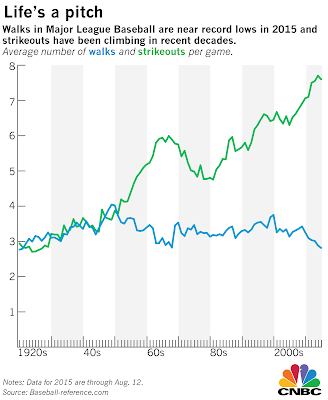
The article states that through August, Major League Baseball saw an average of 2.8 walks per game. If the season were to end there, that would be the lowest level since the 1920s. Similarly, a lot of the stats show that pitching is dominating over hitting. Strikeouts are up, batting average is down, among other key statistics.
"Back in the 1990s, there was a panic in the industry
about lack of pitching," Beane told CNBC. "Now you have a big wave of
pitching that is physically so much different."
Beane noted the increase in physical domination of today's pitcher. "When I was playing, you might have a few guys that threw over 90 miles per hour, but now you have entire staffs where average velocity on fastballs is 2-3 mph faster than a few years ago."
The average fastball in the first half of 2015 left the pitcher's hand at 91.7 mph, according to Major League
Baseball's pitch(f)x database. That's more than a full mph faster than the 2008 average of 90.6.
All-Star hitters agree. "The pitchers these days throw harder and can throw their off-speed pitches for strikes," Mark Teixeira told CNBC. "They're just better."
The New York Yankees first baseman agreed with Beane that this year in particular has been different. "It is definitely getting hard to walk in the big leagues. I feel the trend started a few years ago and is getting more pronounced this season."
During the steroid era, hitters were much more aggressive at the plate because the key stats to earn large contracts were home runs and RBIs. The big hitters got the big money. It did not matter that they swung and missed at a ton of pitches. It really did not matter that their batting average was below .270. To them, an out was an out - - - it did not matter whether it was a strikeout or a long fly ball to the CF on the warning track.
One of the keys to the Cubs current success has been "draft bats, buy pitching." The young Cub hitters can hit for power, but have been drilled to "accept" a walk to keep an inning alive. That is team play in an generation that is mostly focused on "I."
The Blue Jays recent surge has been triggered by adding more bats to an already potent line up.
On the other hand, the Mets have done the opposite. "Draft pitching, acquire bats." The Mets have the finest young rotation in the majors. It has been dominate all year. The old school saying is "good pitching will always defeat good hitting" is the motto for a Mets playoff run.
Why there are less walks and more strikeouts is because there is no stigma attached to striking out. You don't feel bad or get razzed when you sulk back to the dugout after a K. Likewise, no one rewards a player for getting a walk. It does not add points to a batting average. It is like a kindergarten star on a hand-traced turkey because even teams that stress OBP don't hold their players to it.
"Chicks did the long ball."
Remember?
Well CNBC noticed that walks are way down while strikeouts are way up.

The article states that through August, Major League Baseball saw an average of 2.8 walks per game. If the season were to end there, that would be the lowest level since the 1920s. Similarly, a lot of the stats show that pitching is dominating over hitting. Strikeouts are up, batting average is down, among other key statistics.
"It's like capitalism," said Oakland A's general manager Billy Beane. "You have a
void that needs to be filled, and a whole generation of kids that see
it. You've got talent in the pitching department now that is so far above what it was in the past."
Beane noted the increase in physical domination of today's pitcher. "When I was playing, you might have a few guys that threw over 90 miles per hour, but now you have entire staffs where average velocity on fastballs is 2-3 mph faster than a few years ago."
The average fastball in the first half of 2015 left the pitcher's hand at 91.7 mph, according to Major League
Baseball's pitch(f)x database. That's more than a full mph faster than the 2008 average of 90.6.
All-Star hitters agree. "The pitchers these days throw harder and can throw their off-speed pitches for strikes," Mark Teixeira told CNBC. "They're just better."
The New York Yankees first baseman agreed with Beane that this year in particular has been different. "It is definitely getting hard to walk in the big leagues. I feel the trend started a few years ago and is getting more pronounced this season."
During the steroid era, hitters were much more aggressive at the plate because the key stats to earn large contracts were home runs and RBIs. The big hitters got the big money. It did not matter that they swung and missed at a ton of pitches. It really did not matter that their batting average was below .270. To them, an out was an out - - - it did not matter whether it was a strikeout or a long fly ball to the CF on the warning track.
One of the keys to the Cubs current success has been "draft bats, buy pitching." The young Cub hitters can hit for power, but have been drilled to "accept" a walk to keep an inning alive. That is team play in an generation that is mostly focused on "I."
The Blue Jays recent surge has been triggered by adding more bats to an already potent line up.
On the other hand, the Mets have done the opposite. "Draft pitching, acquire bats." The Mets have the finest young rotation in the majors. It has been dominate all year. The old school saying is "good pitching will always defeat good hitting" is the motto for a Mets playoff run.
Why there are less walks and more strikeouts is because there is no stigma attached to striking out. You don't feel bad or get razzed when you sulk back to the dugout after a K. Likewise, no one rewards a player for getting a walk. It does not add points to a batting average. It is like a kindergarten star on a hand-traced turkey because even teams that stress OBP don't hold their players to it.
June 16, 2015
COMPUTER FOLLIES
Computers are supposed to be productivity tools to help humans manage information.
So two stories about computers and MLB twist that purpose.
First, the Royals and their fan base is accused of trying to stuff the ballot to get at least 7 Royals in the All-Star game. Since it is fan voting and a simple log in, with an email, the un(der)employed KC metro area seems to pulling all-nighters to beef up their Royals votes. It has gotten so silly that .200 hitting Omar Infante is the leading in votes for starting second baseman.
It would not matter if the All Star game remained an exhibition contest. But since MLB instituted interleague play, fans across the country can now see on a regular basis other league's best players. It used to be confined to one All Star a year plus the World Series. But the real cause of concern is that stupid Bud Selig salvage attempt of making the winner of the All Star game the home team for the World Series. Selig's folly let the air out of the former value of winning actual regular season games (since the best record always had home field advantage).
Second, the Cardinals alleged cyberhack scandal has more serious ramifications to baseball. It involves several federal crimes, felonies, which have potential jail sentences of 1 to 5 years. It involves corporate spying allegations on another team's proprietary team information (statistical analysis, scouting reports and trade emails). If the information was used by the organization or front office (and not as spun by some in the media as a rogue IT employee seeking revenge or a prank against a former boss), then a conspiracy charge could take out much of management and/or its credibility. The new commissioner is then put under the hot seat. How does the unprecedented criminal theft of team information fit under the "best interests of baseball" clause? If gambling on baseball is still the death sentence offense in the baseball charter (see, Pete Rose), then what could the penalties be to the Cardinals if they were found guilty of spying?
The NFL came down hard on the Patriots for the seemingly mild cheat of deflating footballs. But the NFL was mad that the Patriots were flaunting the rules, authority and integrity of the game on multiple occasions. The real concern is whether the FBI investigation, with subpoena power and computer expertise to track computer files and transmissions, will lead to a scandal bigger than the original intrusion in the Astros computer servers.
It is really a lack of common sense. Every MLB team has their own computer data base programs. There are plenty of public resources like Fangraphs that are spitting out Moneyball statistics and analysis. Why the Cardinals or its employees would benefit from an Astro hack is the great unknown folly in this story.
So two stories about computers and MLB twist that purpose.
First, the Royals and their fan base is accused of trying to stuff the ballot to get at least 7 Royals in the All-Star game. Since it is fan voting and a simple log in, with an email, the un(der)employed KC metro area seems to pulling all-nighters to beef up their Royals votes. It has gotten so silly that .200 hitting Omar Infante is the leading in votes for starting second baseman.
It would not matter if the All Star game remained an exhibition contest. But since MLB instituted interleague play, fans across the country can now see on a regular basis other league's best players. It used to be confined to one All Star a year plus the World Series. But the real cause of concern is that stupid Bud Selig salvage attempt of making the winner of the All Star game the home team for the World Series. Selig's folly let the air out of the former value of winning actual regular season games (since the best record always had home field advantage).
Second, the Cardinals alleged cyberhack scandal has more serious ramifications to baseball. It involves several federal crimes, felonies, which have potential jail sentences of 1 to 5 years. It involves corporate spying allegations on another team's proprietary team information (statistical analysis, scouting reports and trade emails). If the information was used by the organization or front office (and not as spun by some in the media as a rogue IT employee seeking revenge or a prank against a former boss), then a conspiracy charge could take out much of management and/or its credibility. The new commissioner is then put under the hot seat. How does the unprecedented criminal theft of team information fit under the "best interests of baseball" clause? If gambling on baseball is still the death sentence offense in the baseball charter (see, Pete Rose), then what could the penalties be to the Cardinals if they were found guilty of spying?
The NFL came down hard on the Patriots for the seemingly mild cheat of deflating footballs. But the NFL was mad that the Patriots were flaunting the rules, authority and integrity of the game on multiple occasions. The real concern is whether the FBI investigation, with subpoena power and computer expertise to track computer files and transmissions, will lead to a scandal bigger than the original intrusion in the Astros computer servers.
It is really a lack of common sense. Every MLB team has their own computer data base programs. There are plenty of public resources like Fangraphs that are spitting out Moneyball statistics and analysis. Why the Cardinals or its employees would benefit from an Astro hack is the great unknown folly in this story.
June 15, 2015
TOUGH LOSSES
Every loss is bad. But some losses are harder to take.
When the Rays swept the White Sox this weekend, the Sox stopper, Chris Sale, was his usual self. A dominating performance but dinged by one costly mistake, a 2 run HR. The Sox lost 2-1.
ESPN stated that Sale is just the third pitcher since records were first available in 1914 to have four straight 12 or more strikeout starts. Hall of Famers Pedro Martinez did it three times and Randy Johnson once. Sale has a franchise-best 24 double-digit strikeout games in his career. It was the first time that a White Sox pitcher had 12 or more strikeouts, allowed three hits or fewer and lost.
The White Sox offense has been offensive. Bad. Non-existent. Underperforming would be an understatement.
You would think that Sale's teammates would be motivated to help out their ace who is giving it his all (127 pitches yesterday). The contrast is that the Cubs dugout is much looser in close games than the White Sox. Starlin Castro just had his third walk off hit last night against the Reds. With the DH, one would think the Sox could rally easier than the Cubs.
Sale, 6-3, 3.01 ERA, 1.004 WHIP and 2.1 WAR deserves better support.
When the Rays swept the White Sox this weekend, the Sox stopper, Chris Sale, was his usual self. A dominating performance but dinged by one costly mistake, a 2 run HR. The Sox lost 2-1.
ESPN stated that Sale is just the third pitcher since records were first available in 1914 to have four straight 12 or more strikeout starts. Hall of Famers Pedro Martinez did it three times and Randy Johnson once. Sale has a franchise-best 24 double-digit strikeout games in his career. It was the first time that a White Sox pitcher had 12 or more strikeouts, allowed three hits or fewer and lost.
The White Sox offense has been offensive. Bad. Non-existent. Underperforming would be an understatement.
You would think that Sale's teammates would be motivated to help out their ace who is giving it his all (127 pitches yesterday). The contrast is that the Cubs dugout is much looser in close games than the White Sox. Starlin Castro just had his third walk off hit last night against the Reds. With the DH, one would think the Sox could rally easier than the Cubs.
Sale, 6-3, 3.01 ERA, 1.004 WHIP and 2.1 WAR deserves better support.
May 6, 2015
LASTING LEGENDS
Perhaps since it is the oldest American sport, baseball legends have a shelf life that lasts multiple generations. The best current example of this was today's article marking the 100th anniversary of Babe Ruth's first home run.
It never occurred to me that anyone would be interested in knowing that on May 6, 1915 Ruth hit his first of 714 major league home runs.
But even today's causal fans know about Ruth. He was a larger than life legend from the Golden Age.
He began as a pitcher with the Red Sox. The team owner got in financial trouble, so he sold Ruth to the dreaded rival New York Yankees. This led to the Curse of the Bambino, an excuse fostered by Red Sox fans for decades since their team failed while the Yankees became a championship dynasty.
Ruth, being in New York, held the attention of the national media. He was a celebrity. His off the field pursuits, beer, food, women, were covered as much as the game stories. He was an every man and a superman. His home run totals for his era far exceeded his peers. His career WAR is still the gold standard for player performance.
But why does his legacy endure?
Today, we have only scratchy black and white short films and photographs of Ruth. He looks like a large grizzly bear at the plate whipping a stick through the strike zone. He does not look like a modern baseball player.
But the connection is that baseball adores its history. It is stat driven game where people can compare eras based upon objective evidence. Old baseball tales were the bar stories for generations. Fathers past down stories from their fathers to their sons. When a fan base appreciates their sport's history, old players can have a lasting legacy.
It never occurred to me that anyone would be interested in knowing that on May 6, 1915 Ruth hit his first of 714 major league home runs.
But even today's causal fans know about Ruth. He was a larger than life legend from the Golden Age.
He began as a pitcher with the Red Sox. The team owner got in financial trouble, so he sold Ruth to the dreaded rival New York Yankees. This led to the Curse of the Bambino, an excuse fostered by Red Sox fans for decades since their team failed while the Yankees became a championship dynasty.
Ruth, being in New York, held the attention of the national media. He was a celebrity. His off the field pursuits, beer, food, women, were covered as much as the game stories. He was an every man and a superman. His home run totals for his era far exceeded his peers. His career WAR is still the gold standard for player performance.
But why does his legacy endure?
Today, we have only scratchy black and white short films and photographs of Ruth. He looks like a large grizzly bear at the plate whipping a stick through the strike zone. He does not look like a modern baseball player.
But the connection is that baseball adores its history. It is stat driven game where people can compare eras based upon objective evidence. Old baseball tales were the bar stories for generations. Fathers past down stories from their fathers to their sons. When a fan base appreciates their sport's history, old players can have a lasting legacy.
January 29, 2015
CORPORATE SHILLING
Patrick Mooney reports on a notion tossed around by baseball agent Scott Boras.
Having seen the media circus and national attention the NFL gets for its Super Bowl Week, Boras wants MLB to adopt the same format: have a World Series Week at a rotating neutral site.
“Baseball is serving up great steaks and we’re serving it in a drive-thru window,” Boras said. “We’ve got to change that. We need a ‘World Series Week.’ We need the World Series in one city, so that all journalists, from all over the world, can plan a year in advance and come to one place, stay there and watch these two teams go at it for seven days in one spot.”
“We’re talking about the betterment of baseball,” Boras said. “If we continue to do this on a regional scale, we’re going to lose something that baseball deserves. And what it deserves is world attention. And to keep the product at that level, you’ve got to create a platform (so) the world can attend.
“Most corporations and most journalists and most everyone involved — because you don’t know where the World Series is going to be until a day or two in advance — they have not budgeted (for it). They have not funded it. There’s no plan for the attention required to go and focus (on it).
“There’s so much more we can do when we know where the World Series is at. We can have so many events. We can involve corporations. We can have national media, international media. (But not knowing) where the World Series is going to be is making it a regional event.”
But one needs to realize that Boras is talking from a bias. He would like to see MLB generate a ton more money for the league and teams so the money pool grows to pay his clients more money in free agency. As we have seen, professional sports franchises are hitting the ceiling on broadcast revenue channels. Actual fan attendance will probably go down as many teams continue to price the average family out of baseball as an entertainment option.
Adopting another sports "championship set up" can lead to disaster. When the PGA adopted NASCAR's end of season points qualifying system to pare down the field to a small championship chase, it continues to be a confusing disaster. It was so much easier to crown a golf champion based upon earnings rather than a made up point system.
The greatest obstacle to a World Series Week would be the possibility it would take away a national fan base of Cub loyalists the opportunity to see a World Series played at Wrigley would be anarchy at its highest level.
Having seen the media circus and national attention the NFL gets for its Super Bowl Week, Boras wants MLB to adopt the same format: have a World Series Week at a rotating neutral site.
“Baseball is serving up great steaks and we’re serving it in a drive-thru window,” Boras said. “We’ve got to change that. We need a ‘World Series Week.’ We need the World Series in one city, so that all journalists, from all over the world, can plan a year in advance and come to one place, stay there and watch these two teams go at it for seven days in one spot.”
“We’re talking about the betterment of baseball,” Boras said. “If we continue to do this on a regional scale, we’re going to lose something that baseball deserves. And what it deserves is world attention. And to keep the product at that level, you’ve got to create a platform (so) the world can attend.
“Most corporations and most journalists and most everyone involved — because you don’t know where the World Series is going to be until a day or two in advance — they have not budgeted (for it). They have not funded it. There’s no plan for the attention required to go and focus (on it).
“There’s so much more we can do when we know where the World Series is at. We can have so many events. We can involve corporations. We can have national media, international media. (But not knowing) where the World Series is going to be is making it a regional event.”
But one needs to realize that Boras is talking from a bias. He would like to see MLB generate a ton more money for the league and teams so the money pool grows to pay his clients more money in free agency. As we have seen, professional sports franchises are hitting the ceiling on broadcast revenue channels. Actual fan attendance will probably go down as many teams continue to price the average family out of baseball as an entertainment option.
Adopting another sports "championship set up" can lead to disaster. When the PGA adopted NASCAR's end of season points qualifying system to pare down the field to a small championship chase, it continues to be a confusing disaster. It was so much easier to crown a golf champion based upon earnings rather than a made up point system.
The greatest obstacle to a World Series Week would be the possibility it would take away a national fan base of Cub loyalists the opportunity to see a World Series played at Wrigley would be anarchy at its highest level.
November 14, 2014
STANTON AND DELIVER
Giancarlo Stanton could be argued as the best major league baseball player in the NL (Clayton Kershaw fans excepted). Stanton, 25, has amassed a 21.2 career WAR in just 5 seasons, an average of 4.24 WAR/season. In his first year of arbitration, he was awarded $6.5 million. He has two arb years left before FA in 2017.
He is expected to break the bank either way. Several reports state that the Marlins are hot to get Stanton signed for a long, long term deal. ESPN reports it could be a 12 year $300 million deal, while CBS Sports thinks the number could be 13 years $320 million. This is record shattering territory.
Stanton commands these high numbers because of his consistent performance. Season WAR totals: 2.8, 4.1, 5.5, 2.3, and 6.5. His career average for a 162 game season: 39 HR, 102 RBI, .271 BA.
If one uses $5 million/WAR valuation, then Stanton being paid $6.5 million in 2014 was a steal. His performance value would have been $32.5 million. Even if Stanton's arbitration award doubles, he is still only getting paid half his value.
So it may be in the best interests of the player (and his agent) to tap the current controlled value into a long term deal. Teams only do long term deals if it is advantageous to it. The Marlins are a terrible dysfunctional organization with a cheap and arrogant owner. The team burned Miami taxpayers on a new stadium deal; had a fire sale of their veteran talent; and even fired Ozzie Guillen early in his contract term (some of that was Ozzie being Ozzie). Stanton is the one and only shining grace for the franchise.
If one uses the qualifying offer amount of $15.3 million as the floor to negotiations for a top player like Stanton, even a short term extension through his arbitration plus one year of FA would cost the Marlins $46 million. It would be a pay increase for the player, but still very undervalued even at average career WAR ($63.6 million). So the team has to pay a premium to keep Stanton for any free agent year. And it seems to top tier number is Kershaw's $25 million per season number.
Stanton could sign a three year extension for $75 million and hit the free agent market at age 28 for an A-Rod shattering next deal. It comes down to reward of a higher pay day against the risk of premature injury prior to free agency.
In 2012, the Marlins had the 7th highest payroll at $118 million. Then the fire sale, and dropped to the bottom at $36 million in 2013 and $46 million in 2014. Even under the short extension play above, the Marlins would be paying Stanton more than 50% of their payroll on one player. Throughout sports leagues, putting so much capital in one player is dangerous and at times, counterproductive (look at the Bulls and injured Derek Rose who eats of 36% of the team's cap space).
But keeping Stanton may be the Marlins only way to save the franchise from total ruin.
I would expect that any long term deal would be stair-stepped in value (putting more on the back end) hoping that the Marlins could catch fire and be playoff competitive (which equates to more gross revenue). A 10 year extension could be (in millions): $15, 20, 25, 25, 30, 30, 35, 35, 40, 40. That makes the deal worth $295 million. Stanton would become a rich free agent at age 35, and depending on his condition, he could get a Victor Martinez final deal of 4 year/$68 million.
In any event, there will be no charitable tag days ahead for Stanton.
But based upon his statistical value, Stanton has a limited market in trade or in free agency. Very few teams are willing to spend $200 million on one player. Teams would rather keep their top prospects than trade them for expensive veterans. Even the Dodgers and Angels have overspent in the last few seasons, and they now have payroll digestive problems.
A player is worth what the market will bear. Stanton is going to stretch that market to its outer limits.
He is expected to break the bank either way. Several reports state that the Marlins are hot to get Stanton signed for a long, long term deal. ESPN reports it could be a 12 year $300 million deal, while CBS Sports thinks the number could be 13 years $320 million. This is record shattering territory.
Stanton commands these high numbers because of his consistent performance. Season WAR totals: 2.8, 4.1, 5.5, 2.3, and 6.5. His career average for a 162 game season: 39 HR, 102 RBI, .271 BA.
If one uses $5 million/WAR valuation, then Stanton being paid $6.5 million in 2014 was a steal. His performance value would have been $32.5 million. Even if Stanton's arbitration award doubles, he is still only getting paid half his value.
So it may be in the best interests of the player (and his agent) to tap the current controlled value into a long term deal. Teams only do long term deals if it is advantageous to it. The Marlins are a terrible dysfunctional organization with a cheap and arrogant owner. The team burned Miami taxpayers on a new stadium deal; had a fire sale of their veteran talent; and even fired Ozzie Guillen early in his contract term (some of that was Ozzie being Ozzie). Stanton is the one and only shining grace for the franchise.
If one uses the qualifying offer amount of $15.3 million as the floor to negotiations for a top player like Stanton, even a short term extension through his arbitration plus one year of FA would cost the Marlins $46 million. It would be a pay increase for the player, but still very undervalued even at average career WAR ($63.6 million). So the team has to pay a premium to keep Stanton for any free agent year. And it seems to top tier number is Kershaw's $25 million per season number.
Stanton could sign a three year extension for $75 million and hit the free agent market at age 28 for an A-Rod shattering next deal. It comes down to reward of a higher pay day against the risk of premature injury prior to free agency.
In 2012, the Marlins had the 7th highest payroll at $118 million. Then the fire sale, and dropped to the bottom at $36 million in 2013 and $46 million in 2014. Even under the short extension play above, the Marlins would be paying Stanton more than 50% of their payroll on one player. Throughout sports leagues, putting so much capital in one player is dangerous and at times, counterproductive (look at the Bulls and injured Derek Rose who eats of 36% of the team's cap space).
But keeping Stanton may be the Marlins only way to save the franchise from total ruin.
I would expect that any long term deal would be stair-stepped in value (putting more on the back end) hoping that the Marlins could catch fire and be playoff competitive (which equates to more gross revenue). A 10 year extension could be (in millions): $15, 20, 25, 25, 30, 30, 35, 35, 40, 40. That makes the deal worth $295 million. Stanton would become a rich free agent at age 35, and depending on his condition, he could get a Victor Martinez final deal of 4 year/$68 million.
In any event, there will be no charitable tag days ahead for Stanton.
But based upon his statistical value, Stanton has a limited market in trade or in free agency. Very few teams are willing to spend $200 million on one player. Teams would rather keep their top prospects than trade them for expensive veterans. Even the Dodgers and Angels have overspent in the last few seasons, and they now have payroll digestive problems.
A player is worth what the market will bear. Stanton is going to stretch that market to its outer limits.
Subscribe to:
Posts (Atom)